
Fixed Income Insights
In a nutshell
- The Middle East conflict is increasingly a credit event, with disruption around the Strait of Hormuz affecting oil, refined products and LNG volumes more severely than previous shocks
- First-round effects are higher energy costs; second-round effects arise when shortages extend to fertilisers, petrochemicals and helium, impacting food, utilities, autos, metals and semiconductors
- Credit risk can move from linear margin compression to non-linear stress if inventories are depleted and governments resort to rationing, making operational continuity and liquidity more critical than headline earnings
- The current backdrop does not point to a broad defensive stance in global credit, but it does highlight the importance of balance sheet strength, supply chain resilience and pricing power when assessing issuers and sectors exposed to energy and supply disruptions
Global credit: From energy price shocks to supply risk
The Middle East conflict is increasingly a credit event, not because of direct regional exposure alone, but because of the way disruption travels through global supply chains to issuer fundamentals.
Looking beyond energy prices: Second round effects and other shortages can materially impact prices and supply across industries.
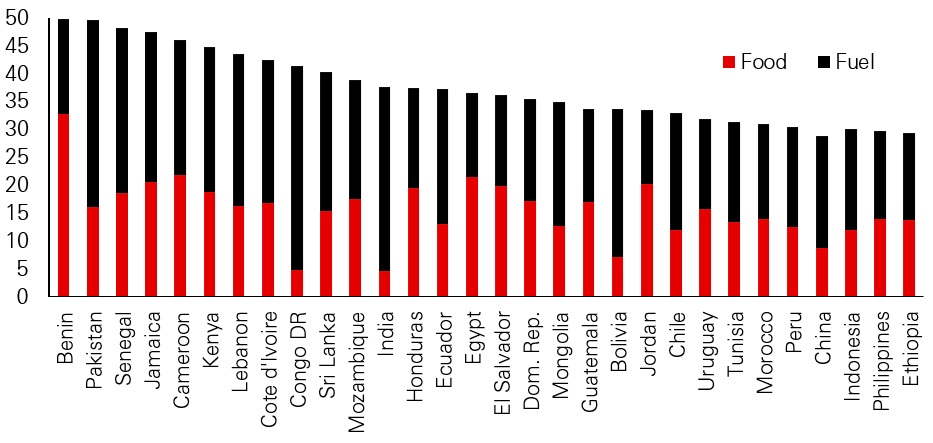
Higher oil, gas and refined product prices feed into input costs, logistics, working capital and consumer demand, but if disruption to supply recurs or worsens, the risk shifts from cost to availability. Naphtha shortages can reduce production of petrochemicals. LNG tightness can pressure gas heavy power systems. Helium disruption can affect semiconductors, aerospace, healthcare, optical fibre and data centre supply chains. Higher fertiliser prices can reinforce food inflation, particularly in emerging markets where households spend a larger share of income on essentials. The Food and Agriculture Organization estimates that a 10 per cent increase in energy prices can translate into a 3–6 per cent increase in food prices, depending on the region, underlining how an energy shock can quickly morph into a social and political pressure point in lower income economies.
A short lived supply disruption can be managed by drawing down inventories (from existing oil on water, strategic and commercial stocks), alternative sourcing, or increasing flows from existing pipelines. Some companies are benefitting from hedging even if facing temporary margin compression but a prolonged disruption shifts the risk from earnings volatility to operational continuity, potentially forcing governments into explicit energy or feedstock rationing and making the shock non-linear rather than incremental. The key credit question then becomes not only whether an issuer can absorb higher costs, but whether it can continue to produce, deliver and fund itself without material balance sheet deterioration, covenant stress or liquidity events.
Figure 1: Oil and food imports across EM (per cent of total imports)
Click the image to enlarge
Source: Bloomberg, HSBC AM, June 2026.
Energy producers benefit from price spikes, but Hormuz disruption cuts supply. Middle distillates (especially jet fuel and diesel) and petrochemicals face shortages into 2027.
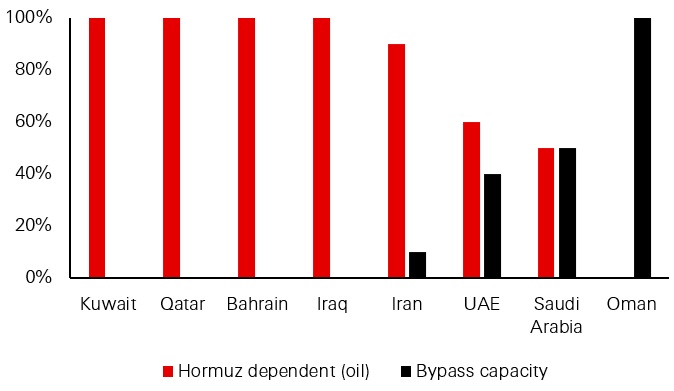
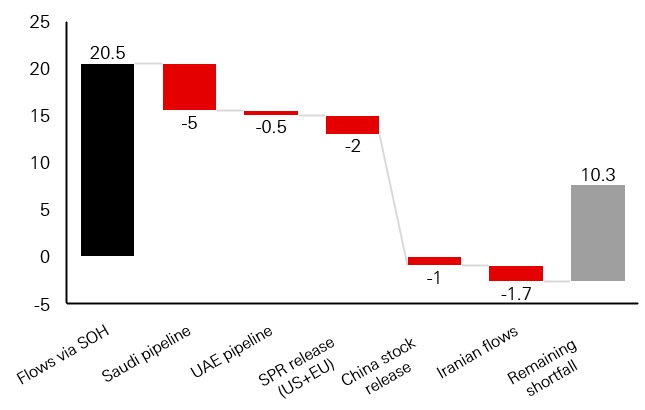
The most immediate beneficiaries are in energy and energy linked sectors, but the credit implications are not uniformly positive. In May, the disruption effectively removed around 10 million barrels per day (mb/d) of crude and oil products from the market, around five times the scale of the Russian supply loss, and roughly 20 per cent of global LNG supply via Qatar has also been compromised. Alternative routes help, but they are constrained. Saudi Arabia’s East-West pipeline normally carries around 2–3mb/d and can theoretically rise to around 7mb/d. The UAE’s Fujairah pipeline can add roughly 0.5mb/d. These routes reduce the pressure, but they cannot fully offset the scale of disruption, particularly when regional infrastructure itself is impacted by attack.
Figure 2: Structural oil export dependence on the Strait across gulf producers
Click the image to enlarge
Figure 3: Offsetting oil and products via Hormuz (Mb/d)
Click the image to enlarge
Source: EIA, Kpler, HSBC AM, June 2026.
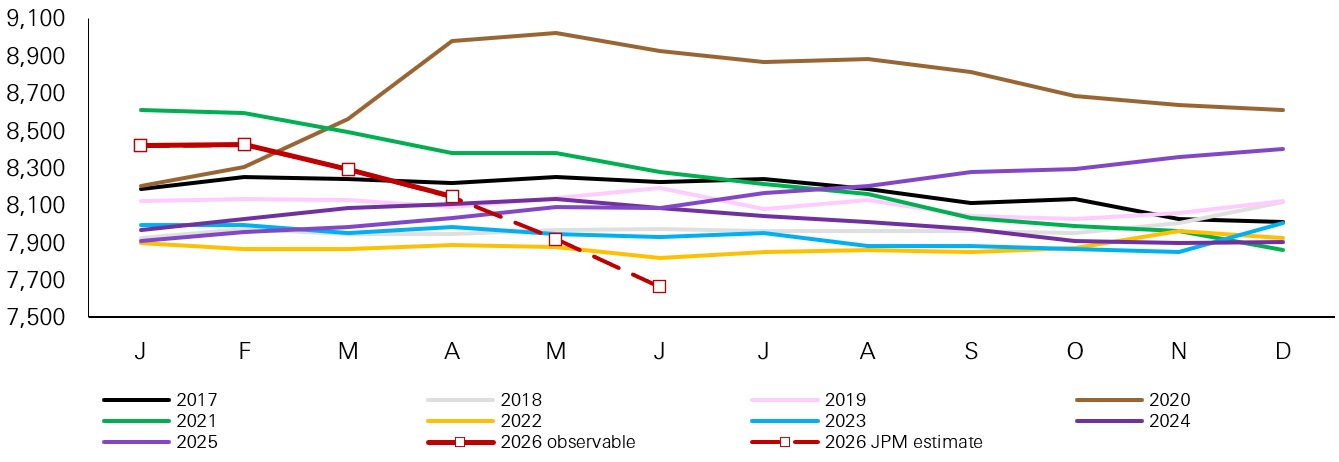
Strategic reserve releases also helped to buffer the shock, including the largest coordinated release in IEA history and national releases from countries such as China. But floating storage moved close to exhaustion and global oil inventories are at more than decade low levels. Even with some reopening of the Strait of Hormuz, the oil system may take two to three months to normalise, assuming limited infrastructure damage and a gradual reopening of shipping insurance, port capacity and trade flows.
Figure 4: Global oil inventories
Click the image to enlarge
Source: J.P. Morgan Commodities Research, JODI, IEA, EIA, Kpler, HSBC AM, June 2026.
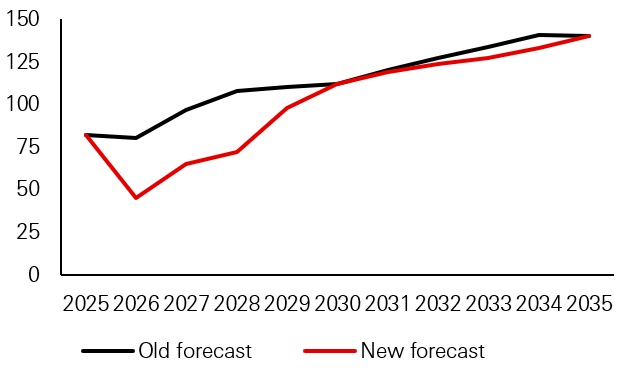
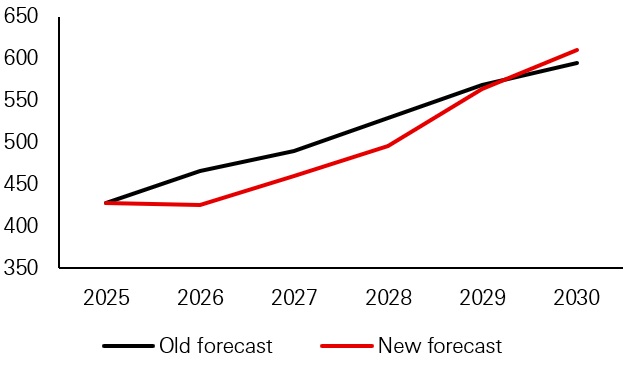
Against this backdrop, upstream oil and gas producers are clear beneficiaries where higher realised prices more than offset any production disruption, particularly for low- cost resource holders and companies with minimal physical exposure to the Gulf. LNG producers and pipeline operators also benefit from higher volumes, though for LNG the earnings uplift is likely to be spread over several years given the expected three-year period of market tightness before new US and Australian capacity fully offset the lost volumes by 2029.
Figure 5: New vs old Qatari LNG exports (mtpa)
Click the image to enlarge
Figure 6: New vs old global LNG supply (mtpa)
Click the image to enlarge
Source: Bloomberg, Jefferies, Energy Aspects, WoodMackenzie, HSBC AM, June 2026.
Refiners are benefitting from record high refining margin especially in middle distillates (diesel and jet fuel). Europe is particularly facing supply risk if the conflict extends by year end as stock deficit may reach critical threshold. Europe is indeed particularly exposed, with around 70 per cent of jet fuel imports at risk as on top of loss of oil products from the Middle East, China and India are now also exporting less oil products, the ban on Russian oil products is still on and exports from the US have now come to a maximum level.
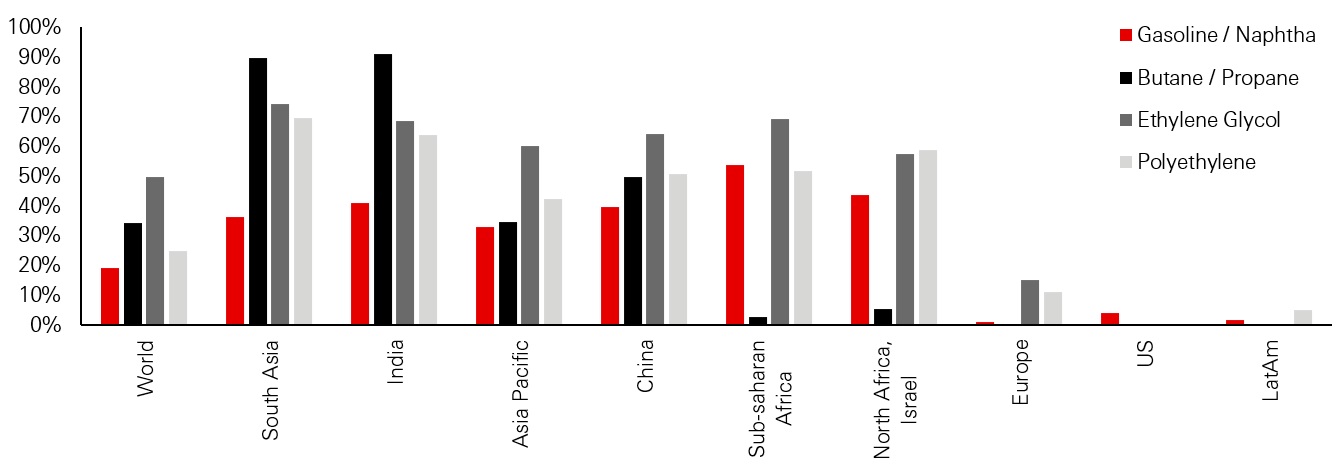
Figure 7: Share of imports from Middle East (per cent)
Click the image to enlarge
Source: S&P Global, HSBC AM, June 2026.
For the Petrochemicals sector, the closure of the Strait of Hormuz disrupted Gulf exports of key products (e.g., PE/PP, sulphuric acid; fertilisers 30 per cent+). Tighter naphtha is forcing Asian producers (mainly ex‑China) into force majeures and lower run rates of production. US ethane/ethylene-advantaged assets are best placed to benefit by exporting low-cost volumes into Asia, while Europe’s naphtha-based crackers may get some uplift from fewer Asian imports, though weak macro demand caps the upside. Even with a rapid reopening, damage, insurance, fuel prioritisation and port constraints could leave supply-chain impacts lingering into 2027.
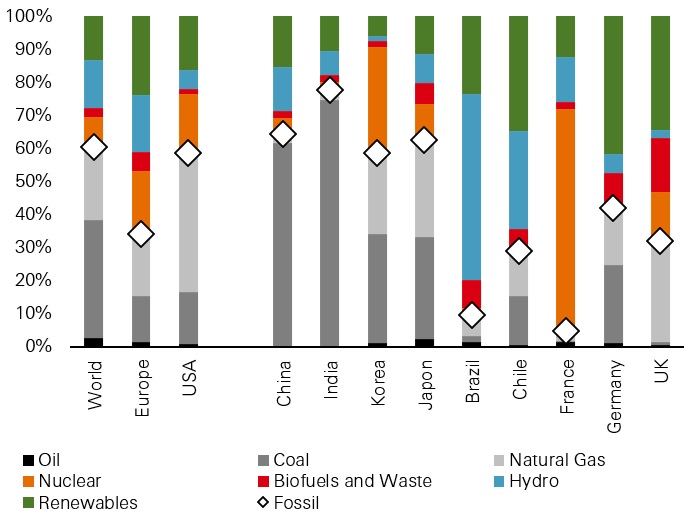
Utility profitability and credit quality depend on the power mix, LNG exposure and pass-through mechanisms. The US is relatively insulated, Europe mainly faces higher and more volatile costs, and Asia is most exposed. These pressures strengthen the case for electrification and regulated grid investment.
For utilities, the impact of supply disruption on profitability and credit quality depends on a number of factors including the power mix, LNG exposure, the strength of pass-through mechanisms and regional variations. Damage to Qatari LNG facilities means the global market could remain tight for around three years, even if the Strait of Hormuz is fully reopened and remains so. That is a very different adjustment profile from oil, where logistics may normalise within a few months if routes reopen and infrastructure damage is limited.
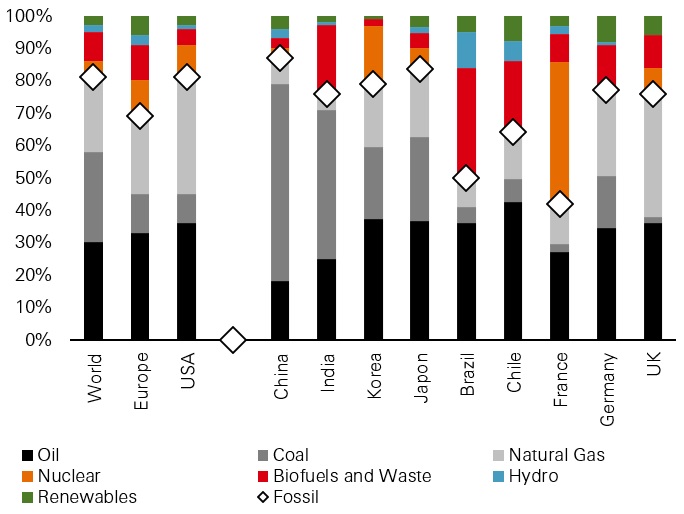
The US is relatively insulated as a net LNG exporter, so that US utilities see limited volume and price risks. Europe is better positioned than during the Russia gas crisis because it has diversified supply, increased LNG imports from the US and hedged a significant portion of utility and industrial gas needs for roughly one to one and a half years. The risk for Europe is therefore less about immediate volume shortage and more about a higher and more volatile cost base feeding into industrial competitiveness and consumer bills over time. Asia, by contrast, is more exposed. Around 90 per cent of Qatar’s LNG exports go to Asia, and several economies maintain a high share of gas fired power. Korea is particularly vulnerable because of its gas heavy power mix, reliance on Qatari LNG and weaker cost pass through record, which can leave integrated power and gas utilities with rising leverage and receivables if tariffs do not adjust sufficiently.
China’s power generators are less exposed because gas represents only around 3 per cent of the power mix, though gas utilities may face lower margins and volumes as higher LNG prices are only partially passed through to industrial customers. Over the longer term, these pressures reinforce the strategic case for electrification, renewables, nuclear, storage and grid investment. China’s energy transition illustrates the scale of change already underway as the country added close to 450GW of solar and wind capacity last year, roughly twice as much as the rest of the world combined, Meanwhile Europe is pushing hard on the electrification of transport and heating while Japan and others reconsider nuclear.
Figure 8: Total energy supply
Click the image to enlarge
Figure 9: Electricity generation
Click the image to enlarge
Total energy supply includes all the energy produced in or imported to a country, minus that which is exported or stored. It represents all the energy required to supply end users in the country. Source: IEA, HSBC AM, June 2026.
For credit investors, this all reinforces the structural importance of regulated networks, grid infrastructure and issuers aligned with energy security and transition themes, which may see more stable regulatory frameworks and capex opportunities despite near term fuel cost volatility.
High fuel prices may depress auto demand and output, worsening pressure from EV transition. Steel/aluminium face energy, freight and chemical cost shocks, while Semiconductors risk helium/power disruptions.
Autos have limited direct Middle East exposure, yet prolonged high fuel prices could weaken consumer confidence, delay purchases and push demand toward smaller, lower margin vehicles, just as global production forecasts are being revised down. 2026 light vehicle production outlook has already been cut by around 2.4 per cent versus flat at the start of the year, roughly half the downward revision seen in 2024 but still meaningful for a sector with high fixed costs. It is manageable for some mass market producers with efficient platforms , who may be able to shift from premium OEMs towards smaller models, but adds cyclical pressure to a sector already facing Chinese EV competition and structural transition.
For steel and aluminium, higher thermal coal and gas demand can lift input costs, while shipping disruption raises freight rates and reduces delivery reliability, particularly for aluminium which is highly dependent on bulk shipping. Steel producers also face potential bottlenecks in industrial chemicals used in processing, which can become constraints when petrochemical supply is tight. Trade protection and local production can partly offset these pressures in the US and Europe, where tariffs and carbon regulation support pricing power for integrated producers, but emerging markets without such protection are more exposed to cost shocks.
Semiconductor production in Korea and Taiwan depends on stable electricity and specialised inputs, particularly helium, ultra pure gases and chemicals. Qatar produces roughly one third of global helium, which is critical for semiconductors, aerospace, healthcare, optical fibre and data centre supply chains. The mitigating factor is that leading chipmakers are better prepared than during previous supply chain disruptions. They typically hold several months of helium inventory, have diversified sourcing from the US and Algeria as the helium market moved into oversupply last year, and are improving recycling processes. In addition, governments increasingly treat semiconductor fabrication as strategic infrastructure, so in a power shortage they are likely to be prioritised, limiting outright shutdown risk. Even so, the credit issue is not simply whether margins compress. It is whether production can continue without yield loss, downtime or expensive restarts.
Emerging market debt is most exposed to Middle East tensions via GCC and Asian importers, while prolonged disruptions may trigger liquidity and sovereign stress. A broad defensive move is not yet warranted, but a prolonged disruption could shift risks from price effects to supply shortages.
Emerging market debt has the highest direct exposure to renewed tension in the middle east through GCC issuers and the dependence of several Asian countries on imported energy and food. EMD also embeds sovereign level vulnerabilities where higher energy and food prices can trigger rating pressure, with knock-on effects for quasi-sovereigns and bank capital structures. Asia feels the supply chain shock earlier and more broadly because its manufacturing base is tightly interconnected and its reliance on Gulf energy and feedstocks is greater. Although many US dollar corporate issuers remain fundamentally resilient and are often quasi-sovereigns or national champions with implicit state support.
Latin America, by contrast, is relatively better insulated through geography and commodity abundance, with several countries net exporters of oil, gas or agricultural products. The US also appears well positioned, benefiting from domestic energy, stronger supply chain resilience and trade protection in some industrial segments. US autos, metals and chemicals are less exposed and in some cases benefit from export opportunities into constrained markets.
Europe sits between these poles being less exposed than Asia to direct Gulf supply, but more vulnerable than the US via higher energy costs, weaker growth and pressure in selected industrials, especially chemicals and autos where Chinese competition and the energy transition already pose structural challenges.
Figure 10: Sector wise regional exposure and risks
| Oil and Gas (upstream) | Medium exposure / Often resilient | Medium / Resilient | Low / Resilient | Medium / Mixed | Higher prices can offset production loss; disruption scale ~10 mb/d |
| Refining and integrated downstream | High exposure / Mixed resilience | High exposure / Mixed | Medium / Mixed | Medium / Mixed | Refining margins rose more than Brent; diesel/jet fuel tightness |
| Jet fuel and diesel-dependent sectors (e.g., airlines, logistics) | High / Lower resilience | High / Lower | Medium / Mixed | High / Lower | Europe: ~70% jet fuel imports at risk |
| Petrochemicals (naphtha-based) | High / Lower | Medium / Mixed | Low / Higher | Low / Mixed | Asia relies on Middle East for ~60% naphtha; force majeure, utilisation cuts |
| Petrochemicals (ethane-based) | Medium / Mixed | Medium / Mixed | Low / Higher | Medium / Mixed | US ethane route advantaged; export margins improved |
| Fertilisers | Medium / Mixed | Medium / Mixed | Medium / Mixed | High / Lower | Energy-to-food pass-through: 10% energy → 3–6% food |
| LNG and gas utilities | High / Lower | Medium / Higher | Low / Higher | Medium / Mixed | LNG tight ~3 years; Qatar ~20% global LNG; Europe hedged ~1–1.5 years |
| Power utilities (overall) | Medium–High / Mixed | Medium / Higher | Low / Higher | Medium / Mixed | Korea vulnerable (spot exposure + weak pass-through); China power mix gas ~3% |
| Autos | Medium / Mixed | Medium / Mixed | Medium / Mixed | Medium / Mixed | Risk shifts from cost to reliability if prolonged; demand timing risk |
| Steel and aluminium | Medium / Mixed | Medium / Mixed | Low–Medium / Higher | Medium / Mixed | Energy intensity + freight disruption; aluminium shipping dependence |
| Semiconductors and tech hardware | High / Mixed | Medium / Mixed | Medium / Mixed | Low / Mixed | Helium risk: Qatar ~1/3 global helium; mitigants: inventory, diversification, recycling |
Source: S&P Global, HSBC AM, June 2026.
For now, developments in the Middle East don’t justify a broad defensive repositioning across credit. It does, however, demand greater selectivity and a focus on balance sheet strength, supply chain resilience and pricing power. If the disruption renews or persists, the associated credit risk is likely to become nonlinear. The shock would then evolve from being primarily price led – where costs rise, margins adjust, and markets reprice – to one driven by depleted inventories, unreliable delivery and potential production rationing. At that point, analysis must move beyond earnings sensitivity to focus on liquidity, working capital management, sovereign linkage risk and the durability of free cash flow under stress.
For informational purposes only and should not be construed as a recommendation to invest in the specific country, product, strategy, sector, or security. The views expressed above were held at the time of preparation and are subject to change without notice. Any forecast, projection or target where provided is indicative only and not guaranteed in any way. HSBC Asset Management accepts no liability for any failure to meet such forecast, projection or target. Source: HSBC Asset Management, July 2026.
Continue reading: Emerging Markets: Resilience Tested, Not Reversed
Important information
For Professional Clients and intermediaries within countries and territories set out below; and for Institutional Investors and Financial Advisors in the US. This document should not be distributed to or relied upon by Retail clients/investors.
The value of investments and the income from them can go down as well as up and investors may not get back the amount originally invested. The performance figures contained in this document relate to past performance, which should not be seen as an indication of future returns. Future returns will depend, inter alia, on market conditions, investment manager’s skill, risk level and fees. Where overseas investments are held the rate of currency exchange may cause the value of such investments to go down as well as up. Investments in emerging markets are by their nature higher risk and potentially more volatile than those inherent in some established markets. Economies in emerging markets generally are heavily dependent upon international trade and, accordingly, have been and may continue to be affected adversely by trade barriers, exchange controls, managed adjustments in relative currency values and other protectionist measures imposed or negotiated by the countries and territories with which they trade. These economies also have been and may continue to be affected adversely by economic conditions in the countries and territories in which they trade.
The contents of this document may not be reproduced or further distributed to any person or entity, whether in whole or in part, for any purpose. All non-authorised reproduction or use of this document will be the responsibility of the user and may lead to legal proceedings. The material contained in this document is for general information purposes only and does not constitute advice or a recommendation to buy or sell investments. Some of the statements contained in this document may be considered forward looking statements which provide current expectations or forecasts of future events. Such forward looking statements are not guarantees of future performance or events and involve risks and uncertainties. Actual results may differ materially from those described in such forward-looking statements as a result of various factors. We do not undertake any obligation to update the forward-looking statements contained herein, or to update the reasons why actual results could differ from those projected in the forward-looking statements. This document has no contractual value and is not by any means intended as a solicitation, nor a recommendation for the purchase or sale of any financial instrument in any jurisdiction in which such an offer is not lawful. The views and opinions expressed herein are those of HSBC Asset Management at the time of preparation and are subject to change at any time. These views may not necessarily indicate current portfolios' composition. Individual portfolios managed by HSBC Asset Management primarily reflect individual clients' objectives, risk preferences, time horizon, and market liquidity. Foreign and emerging markets: investments in foreign markets involve risks such as currency rate fluctuations, potential differences in accounting and taxation policies, as well as possible political, economic, and market risks. These risks are heightened for investments in emerging markets which are also subject to greater illiquidity and volatility than developed foreign markets. This commentary is for information purposes only. It is a marketing communication and does not constitute investment advice or a recommendation to any reader of this content to buy or sell investments nor should it be regarded as investment research. It has not been prepared in accordance with legal requirements designed to promote the independence of investment research and is not subject to any prohibition on dealing ahead of its dissemination. This document is not contractually binding nor are we required to provide this to you by any legislative provision.
All data from HSBC Asset Management unless otherwise specified. Any third-party information has been obtained from sources we believe to be reliable, but which we have not independently verified.
HSBC Asset Management is the brand name for the asset management business of HSBC Group, which includes the investment activities that may be provided through our local regulated entities. HSBC Asset Management is a group of companies in many countries and territories throughout the world that are engaged in investment advisory and fund management activities, which are ultimately owned by HSBC Holdings Plc. (HSBC Group).
- In Australia, this document is issued by HSBC Bank Australia Limited ABN 48 006 434 162, AFSL 232595, for HSBC Global Asset Management (Hong Kong) Limited ARBN 132 834 149 and HSBC Global Asset Management (UK) Limited ARBN 633 929 718. This document is for institutional investors only and is not available for distribution to retail clients (as defined under the Corporations Act). HSBC Global Asset Management (Hong Kong) Limited and HSBC Global Asset Management (UK) Limited are exempt from the requirement to hold an Australian financial services license under the Corporations Act in respect of the financial services they provide. HSBC Global Asset Management (Hong Kong) Limited is regulated by the Securities and Futures Commission of Hong Kong under the Hong Kong laws, which differ from Australian laws. HSBC Global Asset Management (UK) Limited is regulated by the Financial Conduct Authority of the United Kingdom and, for the avoidance of doubt, includes the Financial Services Authority of the United Kingdom as it was previously known before 1 April 2013, under the laws of the United Kingdom, which differ from Australian laws;
- In Bermuda, this document is issued by HSBC Global Asset Management (Bermuda) Limited, of 37 Front Street, Hamilton, Bermuda which is licensed to conduct investment business by the Bermuda Monetary Authority;
- In France, Belgium, Netherlands, Luxembourg, Portugal, Greece, Finland, Norway, Denmark, Spain and Sweden this document is issued by HSBC Global Asset Management (France), a Portfolio Management Company authorised by the French regulatory authority AMF (no. GP99026);
- In Germany, this document is issued by HSBC Global Asset Management (Deutschland) GmbH which is regulated by BaFin (German clients) respective by the Austrian Financial Market Supervision FMA (Austrian clients);
- In Hong Kong, this document is issued by HSBC Global Asset Management (Hong Kong) Limited, which is regulated by the Securities and Futures Commission. This content has not been reviewed by the Securities and Futures Commission;
- In India, this document is issued by HSBC Asset Management (India) Pvt Ltd. which is regulated by the Securities and Exchange Board of India;
- In Italy, this document is issued by HSBC Global Asset Management (France), a Portfolio Management Company authorised by the French regulatory authority AMF (no. GP99026), through its Italian branch, regulated by Banca d’Italia and Commissione Nazionale per le Società e la Borsa (Consob);
- In Japan, this document is issued by HSBC Asset Management (Japan) Ltd (JRN 3010001124868), regulated by the Financial Services Agency;
- In Malta, this document is issued by HSBC Global Asset Management (Malta) Limited which is regulated and licensed to conduct Investment Services by the Malta Financial Services Authority under the Investment Services Act;
- In Mexico, this document is issued by HSBC Global Asset Management (Mexico), SA de CV, Sociedad Operadora de Fondos de Inversión, Grupo Financiero HSBC which is regulated by Comisión Nacional Bancaria y de Valores;
- In the United Arab Emirates, this document is issued by HSBC Investment Funds (Luxembourg) S.A. – Dubai Branch (Level 20, HSBC Tower, PO Box 66, Downtown Dubai, United Arab Emirates) regulated by the Capital Market Authority (CMA) in the UAE to conduct investment fund management, portfolios management, fund administration activities (CMA Category 2 license No.20200000336) and promotion activities (CMA Category 5 license No.20200000327).
- In the United Arab Emirates, this document is issued by HSBC Global Asset Management MENA, a unit within HSBC Bank Middle East Limited, U.A.E Branch, PO Box 66 Dubai, UAE, regulated by the Central Bank of the U.A.E. and the Capital Market Authority in the UAE under CMA license number 602004 for the purpose of this promotion and lead regulated by the Dubai Financial Services Authority. HSBC Bank Middle East Limited is a member of the HSBC Group and HSBC Global Asset Management MENA are marketing the relevant product only in a sub-distributing capacity on a principal-to-principal basis. HSBC Global Asset Management MENA may not be licensed under the laws of the recipient’s country of residence and therefore may not be subject to supervision of the local regulator in the recipient’s country of residence. One of more of the products and services of the manufacturer may not have been approved by or registered with the local regulator and the assets may be booked outside of the recipient’s country of residence.
- In Singapore, this document is issued by HSBC Global Asset Management (Singapore) Limited, which is regulated by the Monetary Authority of Singapore. The content in the document/video has not been reviewed by the Monetary Authority of Singapore;
- In Switzerland, this document is issued by HSBC Global Asset Management (Switzerland) AG. This document is intended for professional investor use only. For opting in and opting out according to FinSA, please refer to our website; if you wish to change your client categorization, please inform us. HSBC Global Asset Management (Switzerland) AG having its registered office at Gartenstrasse 26, PO Box, CH-8002 Zurich has a licence as an asset manager of collective investment schemes and as a representative of foreign collective investment schemes. Disputes regarding legal claims between the Client and HSBC Global Asset Management (Switzerland) AG can be settled by an ombudsman in mediation proceedings. HSBC Global Asset Management (Switzerland) AG is affiliated to the ombudsman FINOS having its registered address at Talstrasse 20, 8001 Zurich. There are general risks associated with financial instruments, please refer to the Swiss Banking Association (“SBA”) Brochure “Risks Involved in Trading in Financial Instruments”;
- In Taiwan, this document is issued by HSBC Global Asset Management (Taiwan) Limited which is regulated by the Financial Supervisory Commission R.O.C. (Taiwan);
- In Turkiye, this document is issued by HSBC Asset Management A.S. Turkiye (AMTU) which is regulated by Capital Markets Board of Turkiye. Any information here is not intended to distribute in any jurisdiction where AMTU does not have a right to. Any views here should not be perceived as investment advice, product/service offer and/or promise of income. Information given here might not be suitable for all investors and investors should be giving their own independent decisions. The investment information, comments and advice given herein are not part of investment advice activity. Investment advice services are provided by authorized institutions to persons and entities privately by considering their risk and return preferences, whereas the comments and advice included herein are of a general nature. Therefore, they may not fit your financial situation and risk and return preferences. For this reason, making an investment decision only by relying on the information given herein may not give rise to results that fit your expectations.
- In the UK, this document is issued by HSBC Global Asset Management (UK) Limited, which is authorised and regulated by the Financial Conduct Authority;
- In the US, this document is issued by HSBC Securities (USA) Inc., an HSBC broker dealer registered in the US with the Securities and Exchange Commission under the Securities Exchange Act of 1934. HSBC Securities (USA) Inc. is also a member of NYSE/FINRA/SIPC. HSBC Securities (USA) Inc. is not authorized by or registered with any other non-US regulatory authority. The contents of this document are confidential and may not be reproduced or further distributed to any person or entity, whether in whole or in part, for any purpose without prior written permission.
- In Chile, operations by HSBC's headquarters or other offices of this bank located abroad are not subject to Chilean inspections or regulations and are not covered by warranty of the Chilean state. Obtain information about the state guarantee to deposits at your bank or on www.cmfchile.cl;
- In Colombia, HSBC Bank USA NA has an authorized representative by the Superintendencia Financiera de Colombia (SFC) whereby its activities conform to the General Legal Financial System. SFC has not reviewed the information provided to the investor. This document is for the exclusive use of institutional investors in Colombia and is not for public distribution;
- In Costa Rica, the Fund and any other products or services referenced in this document are not registered with the Superintendencia General de Valores (“SUGEVAL”) and no regulator or government authority has reviewed this document, or the merits of the products and services referenced herein. This document is directed at and intended for institutional investors only.
- In Peru, HSBC Bank USA NA has an authorized representative by the Superintendencia de Banca y Seguros in Perú whereby its activities conform to the General Legal Financial System - Law No. 26702. Funds have not been registered before the Superintendencia del Mercado de Valores (SMV) and are being placed by means of a private offer. SMV has not reviewed the information provided to the investor. This document is for the exclusive use of institutional investors in Perú and is not for public distribution;
- In Uruguay, operations by HSBC's headquarters or other offices of this bank located abroad are not subject to Uruguayan inspections or regulations and are not covered by warranty of the Uruguayan state. Further information may be obtained about the state guarantee to deposits at your bank or on www.bcu.gub.uy.
Copyright © HSBC Global Asset Management Limited 2026. All rights reserved. No part of this publication may be reproduced, stored in a retrieval system, or transmitted, on any form or by any means, electronic, mechanical, photocopying, recording, or otherwise, without the prior written permission of HSBC Asset Management.
Content ID: D076048; Expiry Date: 30.06.2027