

Decode the Circular Economy and REthink the future
Transitioning to the Circular Economy is critical to ease demand on our planet’s natural resources and deliver sustainable economic growth. Regenerative by design, the Circular Economy minimises waste while providing a new world of opportunity for investors where preservation drives prosperity.
HSBC Asset Management is decoding the Circular Economy to enable investors to rethink their investments and become part of the solution. As part of this move forward, we have launched our Global Equity Circular Economy strategy.
What is a Circular Economy?

Repositioning to a Circular Economy
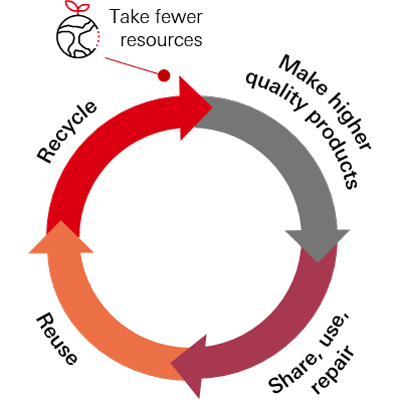
The Circular Economy means that we move towards a ‘scarcity’ approach, minimising waste and doing more with less resources.
|
|
Companies “do more with less” resources
|
|
|
|
Products are used for longer
|
|
|
|
Closing the loop and minimising waste: after use, products serve as inputs
|
|



Source: HSBC Asset Management, June 2022. The commentary and analysis presented in this document reflect the opinion of HSBC Asset Management on the markets, according to the information available to date. They do not constitute any kind of commitment from HSBC Asset Management.
Why should we act now?
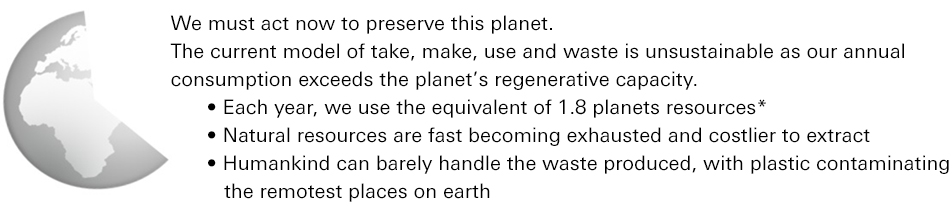
*Data as at April 2020. Source: Message for Earth Day 2020 , an ecological footprint of 1.8 planets is the quantity of nature it takes to support the world’s population and economy.
Current linear model: take, make, use, waste

|
|
Exhaustion of natural resources and water pollution
|
|
|
Soaring CO2 emissions and waste
|
|
|
Deterioration of Biodiversity and living conditions
|


All stakeholders are now embracing the Circular Economy transition

Regulators and Governments worldwide are moving fast forward on Circular Economy
|
Society calls for action…
|
Investors and companies are ready for Circular Economy integration
|
1: January 2022, Visualized: The Circular Economy 101
2: June 2019, Plastic pollution facts and information
3: June 2022, Climate Change - United Nations Sustainable Development
4: May 2022, Waste and recycling
*IPCC = Intergovernmental Panel on Climate Change, **KPIs = Key Performance Indicators Source: HSBC Asset Management. June 2022. The commentary and analysis presented in this document reflect the opinion of HSBC Asset Management on the markets, according to the information available to date. They do not constitute any kind of commitment from HSBC Asset Management.
***EU taxonomy for sustainable activities
How does a Circular Economy help preserve our planet?
Circular Economy, a solution to the resources crisis, for decarbonisation and biodiversity protection
Circular Economy model: 3 key principles
|
|
Minimising waste and pollution generated
|
|
Keeping products and materials in use and at the highest value for as long as possible
|
|
Regenerating natural and social systems
|




|
|
Preservation of natural resources
|
|
|
Net Zero-emissions requires circularity
|
|
|
Safeguard Biodiversity and living standards
|
Circular Economy helps resolve the world’s most pressing challenges
Investors are catalysing change through portfolios focussed on the UN's Sustainable Development Goals (SDG's). Circular Economy delivers on all 17 SGDs, especially:

 Every second, the equivalent of a rubbish truck load of clothes is burnt or buried in landfill.In a Circular Economy for fashion, products are used more, made from safe and recycled or renewable inputs. They are “made to be remade”, recycled or composted and hazardous substances to health or the environment are designed out3
Example for Goal 6: Clean Water & Sanitation
72 per cent of all water withdrawals are used by agriculture4. The most impacted regions – West Asia and Pacific – export scarce water through food and cotton products to net importers like Europe and North America.In a Circular Economy, efficient textile and food production means a massive decrease in water stress in Asia.
1: January 2022, Visualized: The Circular Economy 101
2: The Global Circularity Report 2021
3: Source: Fashion and a circular economy | Ellen MacArthur Foundation
4: February 2021, Scarcity | UN-Water
Source: HSBC Asset Management, June 2022. The commentary and analysis presented in this document reflect the opinion of HSBC Asset Management on the markets, according to the information available to date. They do not constitute any kind of commitment from HSBC Asset Management.
Why consider investing in a Circular Economy
An opportunity for investors
Investing in solutions to the long-term sustainability challenges we face offers an added benefit for those who want their capital to contribute to improved outcomes beyond investment returns.

Companies
|
|
|

* ROCE = Return on capital employed
Customers
|
|
|

Society
|
|
|
